How the Model Reads Your Work
This guide is about what happens to a character and a world after you press Save. The model does not "remember" your character: on every turn it reads, from scratch, a text assembled from your fields and writes its reply from that text alone. So the quality of a scene comes down to what made it into that text, how much of it there is, and where it sits.
Everything here was measured on a real scene. The scene ran in the published world The White Curtain Falls, with five characters in the room, on the ASAI Mini tier, on 1 October 2026.
Field-by-field walkthroughs are in Creating a Character and Creating a World.
1. One turn, two model calls
A reply in a world scene is written by two calls, and each reads its own text.
- The judge sees short sheets of everyone present (bio and character description cut to ~480 characters), their wants, their items, their secrets in full, the world's laws and the last six turns. It writes no prose; it answers with a decision in JSON.
- The writer sees full sheets of everyone present, voices from the source material, the scene rules and the judge's decision. It writes the prose, but only what the judge allowed.
A one-on-one chat with a character has no judge: a single writer reads the whole sheet.
2. What the writer's prompt is made of
This is how the tokens were spread in the measured scene. The figures are our own estimate, the same counter the editor shows as "Card weight". The provider counted the same turn as 23,635 tokens. Its count also includes the visual-novel sprite catalogue, the hidden plot plan and the judge's decision.
What follows from this:
- The sheets of those in the room weigh the most. Five sheets came to 7,000 tokens, about 1,400 each. Characters who are not in the room appear as a single line: name, role and one-line summary. That is why the one-line summary works everywhere, even when the character is off stage.
- World lore rides along in full on every turn. If the world has an AI summary, only the summary goes in. If it does not, every lore document goes in, one after another.
- What is unique to this turn is the scene state and the judge's decision. It is under a thousand tokens, but it is the part that changes every turn.
2.1 The judge
The judge in the same scene read 11,700 tokens per turn: the rules of judgement, short sheets, states, items and recent turns. It is always smaller than the writer because its sheets are short.
3. Caching: what is paid for again and what is not
The prompt is built in three layers, from the most permanent to the most alive:
The provider remembers the start of the prompt that matched the previous turn and does not recompute it. In the measurement:
The practical rule: everything that changes often goes at the end. We assemble the prompt that way. What matters for you is this. The skill index sits in the stable part, and the full skill text sits in the live part. Loading a skill does not break the world's cache.
4. How the model spreads its attention
The prompt is not memory. It is a text the model reads in full before every reply, and attention across it is uneven. You can use that.
The beginning and the end are read better than the middle. This is a known property of large language models: accuracy drops when the relevant fact sits in the middle of a long context (Liu et al., Lost in the Middle, 2023). So we put the world's laws and the character's sheet near the start, and this turn's state and the judge's decision at the very end. Every extra paragraph in the middle pushes what matters further from the edges.
The specific outweighs the general. The model reproduces "speaks in short regulation phrases: 'No.', 'Found it.', 'May we leave now?'". It turns "strict and disciplined" into the strict hero it has seen a thousand times.
Shown outweighs described. A speech sample and live dialogues from the source set the rhythm better than any description of a manner. In the measured scene the voices weigh 1,448 tokens and earn every one.
Contradictions get averaged. If one field says "never raises his voice" and the backstory has three scenes of him shouting, the model will land somewhere in between. Every statement about a character must hold true wherever it appears.
Whatever is in the prompt will be used. The model tries to apply what it is given. A detailed description of combat techniques in a scene about tea leaks into the tea: the character "instinctively checks his grip", "measures the distance". That is not the model's fault. It is a sign that the text was in the wrong place.
5. Skills
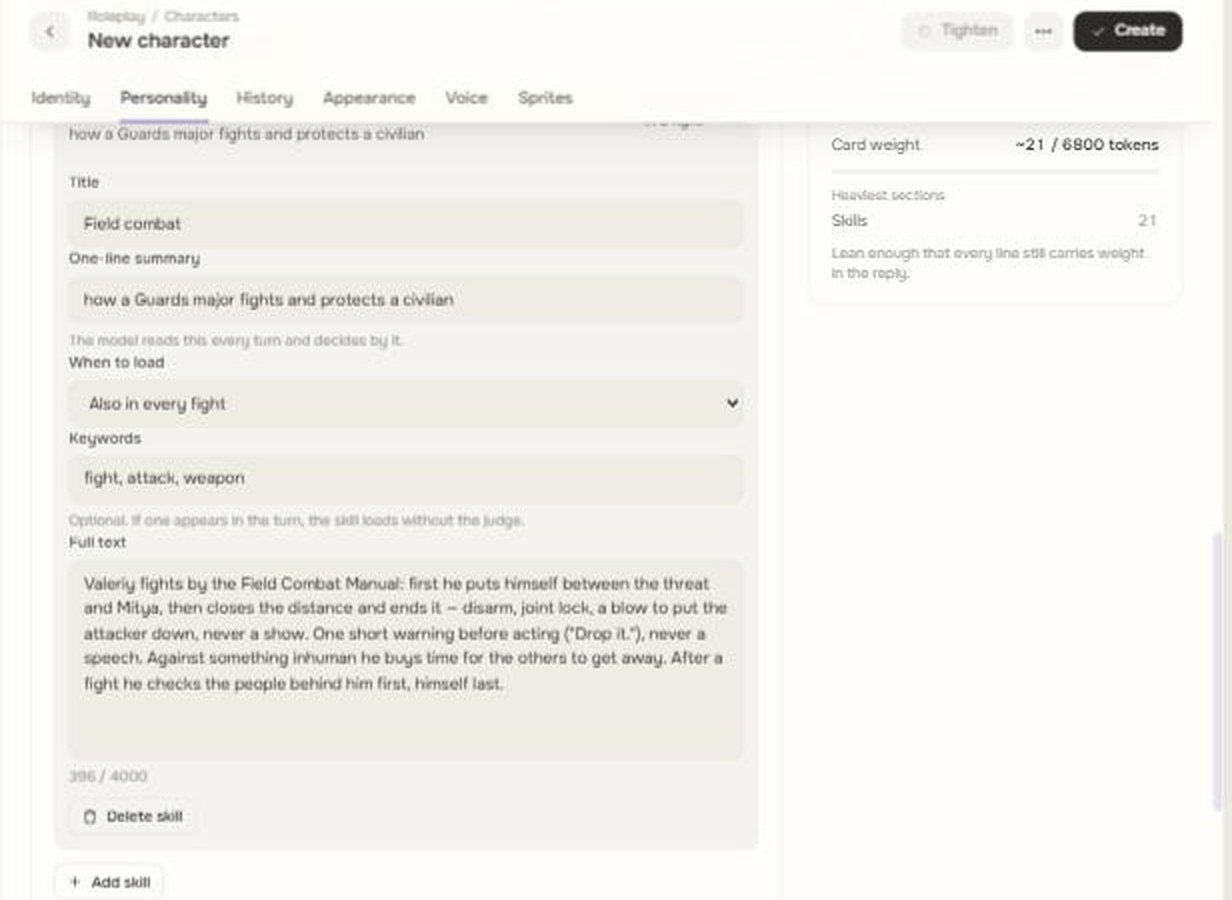
A skill is a reference note on a character or a world card. On every turn the model sees only its title and a one-line summary. The writer gets the full text on the turn where it matters.
5.1 When a skill loads
The full text reaches the writer in one of three ways. No more than three skills load in a single turn.
5.2 What it looked like in the measurement
Valeriy has a combat skill, "Field combat". The world has a skill, "The white beyond the doors", about what lies outside the theatre.
What happened over three turns:
- "I walk to the main doors and go outside." The judge saw only the index line and refused: "To take a step out there is never to come back." The writer is not called on a refused turn, so the skill text did not load.
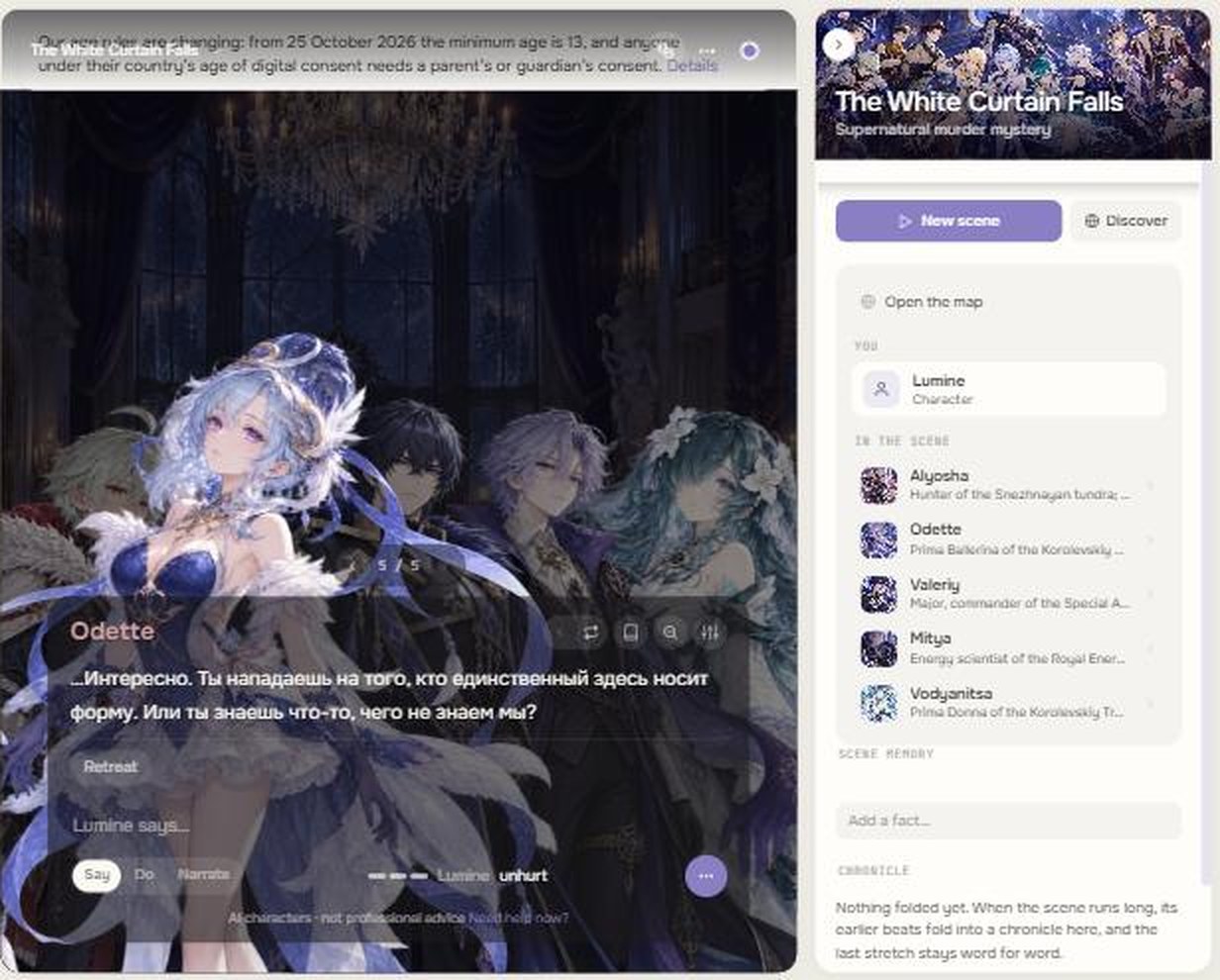
- "Alyosha, what is out there beyond the doors?" The world skill loaded on the keyword "door". The reply used details from its text, "white light, like fog lit from inside" and "those who went out never came back". The characters kept their own voices.
- "I grab a knife and lunge at Valeriy." The judge named the blow and the dice gave a wound. Valeriy's combat skill then loaded on its own. Valeriy caught the wrist, knocked the knife away and gave one short warning, "Drop the knife. Now.", exactly as the skill says: one warning, no speeches.
5.3 What it saves
A worked example for a character with a developed combat system: six techniques of about 600 tokens each.
The gain is not only the price. On turns without a fight, the model has 3,450 fewer tokens pulling it toward a fight. That attention goes to the voice, the character and what is happening in the scene right now.
6. What goes into skills and what stays in the sheet
| Keep in the sheet — needed every turn | Move into skills — needed sometimes |
|---|---|
| The voice: speaking style, sample, live dialogues | Techniques, weapons and combat rules in detail |
| The core of the character and how they behave | A magic system and its limits |
| What the character always knows: their secret, their past in two lines | How a place, district, ship or organisation works |
| Relationships with the people they are usually in scenes with | Notes on an event that comes up rarely |
| One line about their strength: "Guards major, armed" | Professional knowledge: medicine, poisons, lockpicking |
The voice must never go into a skill. If it loads "on demand", the character sounds different from turn to turn.
The test question: "If this text is missing on this turn, does the character become someone else?" If yes, keep it in the sheet. If they just know fewer details, move it into a skill.
6.1 How to write a good skill
- The index line is a promise. The judge decides from it whether the skill is needed, and the writer learns from it that the skill exists. "How a Guards major fights and protects a civilian" is good. "Combat" is not: it gives no clue when to load it.
- The full text is facts and rules, not prose. What they can do, what they cannot, in what order they act, what it costs them. Do not put speaking style here: the voice lives in the sheet.
- Keywords in both scene languages, as a short stem: "door", "двер". A word shorter than three letters is not matched.
- "Also in every fight" is for combat skills only. Let the judge pick the rest.
- One skill, one topic. Three skills of 400 tokens beat one of 1,200: only the one that is needed loads.
7. Card weight and ceilings
The editor shows the card's weight as you type. It counts what sits in the prompt on every turn: all the fields plus the skills' index lines. The full text of the skills is not counted.
| Ceiling | What counts | |
|---|---|---|
| Character | ~6,800 tokens | every sheet field + skill index |
| World | ~12,000 tokens | lore (or the summary), places, relationships, scene starts + the world's skill index |
| Skill | 4,000 characters of text | does not count toward weight; up to 8 per character, 12 per world |
A card over the ceiling can only get lighter. The Tighten button suggests condensed versions of long fields. It leaves speech samples and dialogues alone, because their value lies in being verbatim.
8. Short checklist
- The one-line summary works even when the character is not in the room. Write it so a single line tells you who this is.
- The voice is shown, not described: a speech sample and two or three live dialogues.
- Anything not needed every turn goes into skills, with a clear index line.
- A world with a lot of lore has an AI summary, and the details live in world skills.
- No field contradicts another.
- The weight stays in the green: up to ~900 tokens a character card reads densest.
Version history
- 1.0 — 1 October 2026 — First publication: how a turn works, prompt anatomy from a measurement, caching, the model's attention, skills.