Creating a Character
This guide walks through the character editor tab by tab. For each field it says what the field does and where the model reads it. Common mistakes and a checklist come at the end.
How the model spreads its attention across the text, and why longer is not better, is covered in How the Model Reads Your Work. What you may write in these fields is covered in the Content Policy.
1. Where to start
Do not fill in the fields in order. First answer three questions for yourself, in one paragraph:
- Who is this, in one line? That becomes the one-line summary.
- How do they talk? One or two lines in their voice. That becomes the speech sample.
- What do they want, and what will they never say? That becomes the character description and the secrets.
With those three answers the character is already alive. The other fields refine them; they do not create them.
2. Where the model reads each field
A character lives in two places: in a one-on-one chat and in a world scene. In a world the model gets a shorter sheet, because there may be five people in the room.
| Field | One-on-one chat | In a world, in the room | In a world, not in the room | Scene judge |
|---|---|---|---|---|
| Name, role, pronouns, age | ✓ | ✓ | name and role | name and role |
| One-line summary | ✓ | ✓ | ✓ | ✓ (up to ~480 characters) |
| How they play | ✓ | ✓ | — | ✓ |
| Character description | ✓ | ✓ | — | ✓ (up to ~480 characters) |
| Temperament sliders | ✓ all | ✓ warmth, courage, honesty, verbosity | — | — |
| Defining traits | ✓ | ✓ | — | ✓ |
| Likes / dislikes, strengths, wounds | ✓ | — | — | — |
| Backstory, key events | ✓ | ✓ | — | — |
| Visual notes, clothing | ✓ | — | — | — |
| Speaking style, speech sample | ✓ | ✓ | — | — |
| Example exchanges | ✓ (up to 5) | — | — | — |
| Live dialogues | ✓ (up to 7) | ✓ (2 excerpts) | — | — |
| Power in a fight, weapons | — | ✓ | — | ✓ |
| Skills | index + by keyword | index + on demand | — | index |
| Secrets | titles only | titles only | — | in full |
| Habits, reputation | ✓ | through the world's schedule | through the world's schedule | habits |
| Personality test | ✓ | — | — | — |
| Greeting | ✓ as a tone reference | — | — | — |
| Discover note | — | — | — | — |
What follows from the table:
- The one-line summary is the only field that is always visible. Write it so that a single line makes clear who this is and why they are dangerous or useful.
- Visual notes and clothing never reach the model in a world. If a visual detail matters to the plot ("a scar across the whole face, it's how people recognise him"), add it to the character description.
- In a world, the voice is the speaking style, the speech sample and the first two live dialogues. Example exchanges only work in one-on-one chats.
3. The Identity tab
Name, pronouns, age, role. Keep the role to a word or two: "Guards major", "prima ballerina". It sits in the sheet's header and on the card of those who are absent.
Universe / Fandom. Where the character comes from. For your own character leave it as "Original", and the field stays out of the prompt.
One-line summary. The most important field on the card; see above. Good: "Major of the Armory Palace special battalion, Mitya's bodyguard; speaks by regulation, never leaves his charge." Bad: "A mysterious, powerful warrior with a dark past."
Greeting. The first message of a new one-on-one chat. @nickname is replaced with the other person's name. Afterwards the model treats the greeting as a tone reference, not as text to repeat.
Tags are for search in Discover. The Discover note is shown only on the public page; the model never reads it.
4. The Personality tab
Temperament sliders. Each one turns into a word: "warm", "very cautious". The middle (40–60) gives nothing, because the model does not need to be told that a trait is neutral. In one-on-one chats, Verbosity becomes a hard instruction about reply length: below 20 means one sentence, above 80 means five to ten sentences.
Defining traits. Three to five short words. They are a hint, not a character: "cynical" with no examples gives you the standard cynic.
Character description. The main field for the character. Write behaviour, not adjectives: what they do when afraid, how they say no, what they joke about, what they let slide. In a world, the judge sees the first ~480 characters, so put what matters most first.
How they play. One instruction about behaviour under the world's rules, up to 400 characters: "a detective — takes nobody at their word, asks for proof, checks it himself". The judge ranks it above the character description. It is not one more trait. It is an instruction.
Power in a fight and Weapons, items, abilities. The power tier (Ordinary, Strong, Overlord, Divine) and a list of what they fight with, separated by commas. A server-side dice roll decides each blow, and a difference of two tiers settles it with no roll at all. Keep the list short, up to 400 characters, and move combat details into skills.
Skills. Reference notes the model gets in full only on the turn that needs them: techniques, the rules of their magic, professional knowledge. The sheet carries only a title and one line per skill on every turn. More in section 9 and in How the Model Reads Your Work.
Habits in this world. Where they tend to be and what they do on an ordinary day. The world builds schedules from them: who is where in the morning, who leaves in the evening. Without habits everyone has the same empty day.
Reputation. What strangers have heard about them: poorly spoken of, unremarkable, or well regarded. The model gets a word, not a number. Leave the slider alone if nobody talks about this character.
Likes, dislikes, strengths, wounds. These work in one-on-one chats. Be specific: "can't stand anyone touching his scarf" beats "dislikes familiarity".
Secrets. Up to eight. Each has a title, the content, and the condition under which it may come out. The writer sees only the title. The judge opens the content when the player has earned it over several turns, not because they asked politely. Write titles that give nothing away: "What he saw the night of the fire", not "He set the house on fire".
Personality test. Answers to situations ("someone asks to borrow money…") are a strong way to show behaviour. They work in one-on-one chats.
5. The History tab
Backstory. Only what explains how they behave now. The model will compress five paragraphs of biography anyway, and it spends attention doing it. Good: "Served on the border; learned to sleep lightly and check the doors." Bad: a detailed chronicle of their childhood.
Key events. A timeline of "year — event". Short lines, one per event.
6. The Appearance tab
Visual notes and Clothing style work in one-on-one chats and in image generation. The "Describe with AI" button fills in the appearance from an uploaded portrait.
7. The Voice tab — the most important one
The voice decides whether a character is alive, and it is where people invest the least.
Speaking style. Not "speaks politely" but exactly how: sentence length, pet phrases, how they address people, what they do under pressure. An example from a published character:
Formal, complete sentences in a military register, almost no contractions. Under pressure the answers get shorter: 'No.', 'Found it.', 'May we leave now?'. Addresses people as 'Mr. Mitya', 'Miss Odette'.
Speech sample. One or two lines in their voice. The model copies the rhythm.
Register and verbosity. Vernacular, formal or archaic; terse, normal or verbose.
Example exchanges. "Someone said → they replied" pairs, up to five. They work in one-on-one chats.
Live dialogues. Excerpts with the character from the source material, as they are, up to seven. In a world the model takes the first two (about 900 characters each) of everyone in the room. It reproduces the voice from them but never repeats the words. Put the most characteristic excerpt first.
8. The Sprites tab
A sprite is a full-length figure on a transparent background for visual-novel mode. You can have up to ten poses. Each has a name and a hint ("calm", "angry", "laughing"), and the model picks a pose for each line by its hint. Without at least one sprite, the character cannot step onto the visual-novel stage. You can also pin the backdrop their visual novel opens on.
9. Character skills, by example
The "Field combat" skill of Valeriy from The White Curtain Falls:
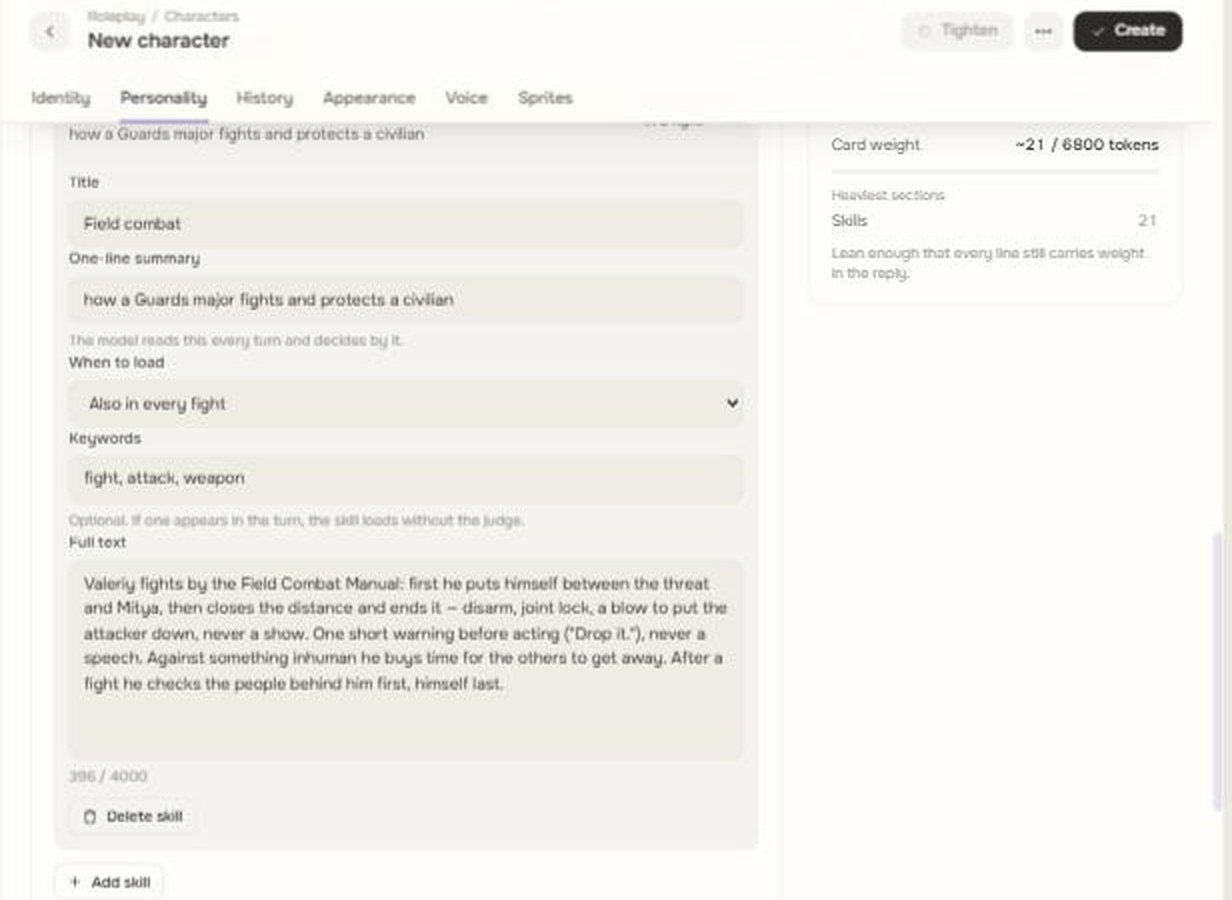
- Title: Field combat.
- One-line summary: how a Guards major fights and protects a civilian. The model sees this line every turn.
- When to load: "Also in every fight". The skill loads on its own whenever Valeriy fights.
- Keywords: fight, attack, weapon, бой, драк, напад.
- Full text: his order of action in a fight. He stands between the threat and the person he protects, disarms, gives one short warning and makes no speeches.
In a live scene, when attacked with a knife, Valeriy caught the wrist, knocked the knife away and said exactly one thing: "Drop the knife. Now."
10. Card weight
On the right of the editor sits Card weight: how many tokens the card adds to every turn and which fields weigh the most. The ceiling is ~6,800 tokens. Up to ~900 the card reads densest; past ~1,600 the fields start competing with each other.
The Tighten button suggests condensed versions of long fields. It leaves speech samples, dialogues and the greeting alone, because their value lies in being verbatim.
11. Common mistakes
One-line summary: "A mysterious girl with a dark past"
Speaking style: "Speaks beautifully and mysteriously"
Character: "kind but strict, cheerful but serious"
A 3,000-word backstory
Magic details inside the character descriptionOne-line summary: "Prima ballerina; at night, a Fatui agent"
Speaking style: "Short: 'Fine.', 'Here we go again.' Many lines start with '…'"
Character: what she does when cornered, and what she will never say
Backstory: only what explains how she behaves now
Magic in a skill; one line about it in the sheet12. Checklist before publishing
- The one-line summary answers "who is this" in one line.
- The speaking style describes the shape of their speech concretely, and there is a sample.
- There are two or three live dialogues, the most characteristic one first.
- The character description is about behaviour, with the essentials in the first two sentences.
- No field contradicts another.
- Combat, magic and professional details are in skills with a clear index line.
- Secret titles give nothing away.
- There is at least one sprite, if the character will appear in the visual novel.
- The weight is in the green or yellow zone.
Publishing is a separate step with its own rules: Creator Program and Ownership & Licence.
Version history
- 1.0 — 1 October 2026 — First publication.